Watching my seven-month old granddaughter yesterday, I was struck by how similar our temperaments are. Both of us light up around people, but grow tired with too much stimulation. Solitude recharges our batteries. Naps for Lydia Rose. Walks for me.Monday, February 08, 2010
Understanding Our Differences
Watching my seven-month old granddaughter yesterday, I was struck by how similar our temperaments are. Both of us light up around people, but grow tired with too much stimulation. Solitude recharges our batteries. Naps for Lydia Rose. Walks for me.Monday, August 24, 2009
I'm Back
Is it done? No.
I’d hoped it would be finished by the time I started blogging again, but at least I’m on the downward stretch and can see the proverbial light at the end of the tunnel. There were times I doubted I had the stamina, let alone the skill, to write a readable story, but I kept working at my craft, cranking out the pages.
Why am I telling you this? Because there’s a lesson here:
Even if you’re not sure you’ve got what it takes to do what you dream of doing, go for it. Take classes, if you think that would help. Join some kind of support group, if you’re the kind of person who needs encouragement. Find a mentor. Experiment. Perhaps even take a break for a while. (I did all of these.)
But don’t give up.
P.S. I became a first-time grandmother this summer. Here are two photos of Lydia Rose, born July 2nd in New York City--one of her with her father, my 33-year old son Gabe; the other with my 86-year old mom and me. What an incredible experience it's been watching my child nurture his child!
Sunday, September 21, 2008
Laughing at Ourselves, cont.
Monday, September 15, 2008
Exercise of the Week: Practicing Silence
When my husband was in college in the early '70s, he spent an entire semester not speaking except during class. Practicing silence, he tells me, not only heightened his senses but upped the volume of his inner voice. It also made him aware of how much people talk and how little they say.Today we talk more than ever. We walk around with little plastic boxes held to our ears, jabbering into space, oblivious to the people and beauty all around us. Precious moments of time that we might have once spent in thought, or reverie--driving to work, walking down the street, even waiting in line at the grocery store--are sucked up in a vortex of ever-growing obligation to be in constant contact with others. The only person it seems we're not in touch with is ourselves.
So this week, I challenge you to try one of the following:
- Take a walk in pure silence.
- Meditate for ten minutes.
- Drive home from work in silence--no cell phone, no radio, no talking.
- Practice silence for a day, speaking only when absolutely essential.
- At a minimum, leave your mobile device at home, or at least turned off and tucked away, one time this week when you're out with friends or family.
Photo credit: Getty Images
Monday, September 08, 2008
Exercise of the Week: Imagining Your Legacy
This exercise answers the question: "How do I want to be remembered?" When I was teaching, I assigned it in tandem with my "Imagine You're Ninety" exercise. (See my 8/18/08 posting.) In essence, you're writing your epitaph. Sound morbid? Just try it. I think you'll find it an enlivening challenge.
- Once again, imagine that you're 90, taking your last breath.
- What would you hope to have inscribed on your tombstone?
- Honesty - Integrity - Humanity
- A Teacher to the End
- Pioneering Scientist & Physician
- A Friend to Nature & All Living Things
- Loving Husband - Caring Father - Loyal Friend
Note: Pictured above is my dad's tombstone.
Friday, September 05, 2008
Lightening Up: Part II
Thursday, August 28, 2008
With a Little Help From Our Friends
One of the best ways to cope with the uncertainties of growing old, researchers say, is to strengthen our connections with others. The two-and-a-half minute video below was taken on my mom's 85th birthday. Four generations of my family, all living nearby, came together at my place to celebrate. I don't expect that you'll want to watch this; I'm just excited that I was able to upload it from my my camera phone without technical assistance!
Friday, August 15, 2008
Speaking About Potential...
Note: After the debate, Dennis Kucinich personally responded to Ev's question.
Monday, July 28, 2008
Thoughts I Normally Keep to Myself
Dear Diary,
(Just kidding!)
Last night I watched on Netflix the conclusion of Season 2 of Six Feet Under, along with writer/director Alan Ball's commentary. He talked about how repressed the whole cast of characters is with their feelings, what WASPS the Fishers are. Even when David expresses his fears about his brother Nate's upcoming surgery, Ball loves the poignant scene but thinks David should be weeping the way he does with his lover Keith later in the episode--that he needs to let out and excavate his emotions.
A few thoughts about all this:
One: In examining how I structure sentences, it's interesting to me how many dependent clauses, buts, and parenthetical thoughts I use. (TB used to say that my most interesting thoughts are in parentheses.)
What does this have to do with Six Feet Under? It occurs to me that perhaps I, too, am incredibly repressed, so much so that I didn't pick up on this major theme as I was watching the show. The characters and the way they express themselves seem normal to me. I see Ruth as my shadow self, insecure and even passive-aggressive at times. Ball, however, doesn't judge her. He thinks that his characters are the most beautiful when they're the most vulnerable. As they reveal their true feelings, everyone around them is propelled forward.
I rarely show my vulnerability in its raw state. I hide it within the parentheses. No wonder I'm having trouble telling a story. To write a novel is one of the most vulnerable things one can do. First, one must excavate one's own heart to understand the feelings of another and bring a character to life. And then, ultimately, one must allow one's work to be read and judged by others.
So what am I repressing? What feelings do I hide from myself and others? Do I need therapy? ACOA? (It amazed me to hear Ball speak so highly of the latter. To me, at least the Brenda part of me, 12-step programs seem so tedious.) Maybe my issues are not that big a deal. I'm just human. (That's the position I've always taken.) But playing the devil's advocate, what might I be repressing?
Anger at my father? I have such complicated feelings toward him. On one hand, he is the most likely cause of my control issues. (I love my house, but really, does it have to be so neat?) He constantly scrutinized me, f-----d with my head. I was never good enough, honest enough, smart enough. I never felt safe in my own house except when he wasn't there.
As I write this, I want to yawn. No new revelations here. What good would it do to yell now? Where would the rage land? Right back on me. And besides, my father was also a product of his upbringing. I truly believe he did the best he could. I truly believe he loved me. I have a lot of him in me--his fire, his drive, his warmth, his humor.
But back to repressed emotions. Pretending this page is a dear and trusted friend (as my teacher Suzanne Hoover suggested I do as I draft my novel--to write as if to a non-judging, dear friend who is hanging on my every word), what would I reveal?
Well...I'm afraid I don't have the talent to write a decent novel. Fair enough. I might not. But, and here's the rub, what will I do with my life, with the next forty+ years, if I don't write? I don't have the all-consuming interests my mother has. I'm not an avid gardener or a painter. I want to live a life as large as my spirit, as I say in DG. I want to be a novelist, but I want it to be easier. I also want to continue speaking, but ethically I can only keep doing this if I'm practicing what I preach. I adore teaching, but it's confining--or at least it has been for me in the past. . . .
Regardless of being a so-called authority on late blooming, in other words, I'm really not all that different from many of the people who write me through my website.
I keep coming back to my novel.
Problems with the novel: Voice. Mine is stilted. Hence the trusted friend advice. Plot. Mine isn't twisted enough. I've been avoiding getting Catherine [my protagonist] into trouble, avoiding putting her against the wall.
Just like I do with myself.
Note: Since I posted this entry, I've edited it several times. I couldn't help myself.
Saturday, July 19, 2008
A Choice

This morning I'm off to Cuttyhunk, a small island seven miles off the coast of Martha's Vineyard. My fifth major trip this summer. I know it seems like I have a wonderful life, and I do. But I'm exhausted. I have to remind myself that these trips are my choice and that I've had a good reason for each. Sometimes just acknowledging this simple fact--that even when we think we don't have a choice, we do--is all it takes to get re-energized. (I need to hear this today.)
Sunday, May 04, 2008
Appreciating the Sunshine
The sky this morning is a crisp blue, not a cloud in sight. But for the past few days I've been nursing a nasty cold and feeling miserable. To put my situation in perspective, I decided last night to watch The Diving Bell and the Butterfly on DVD. As I hoped, director Julian Schnabel's portrayal of former French Elle editor Jean-Dominique Bauby, who was left paralyzed after a massive stroke at age 42, left me in awe.
About the film, NY Times movie critic A.O. Scott writes:
Diving Bell is the third feature directed by Julian Schnabel, and its visual dynamism can surely be traced to his first career, as a painter. But the sensory abundance of its sounds and pictures is also a response to the movie’s subject, which is sensory deprivation. Its protagonist, played by Mathieu Amalric, is a high-living, womanizing magazine editor paralyzed by a stroke and able to engage the world only through his left eye.
Blinking is his only means of communication, and the film’s plot essentially involves the composition of the memoir on which it is based, with excursions into its hero’s earlier life and loves. But the true brilliance of “The Diving Bell” resides in how thoroughly Mr. Schnabel dispenses with conventional narrative structure without sacrificing clarity, emotion or pleasure. Rarely has a film about an appalling, tragic circumstance been so thoroughly and convincingly charged with joy.
In the face of Bauby's refusal to succumb to despair, how can I, sniffles and all, not be thankful for the sunshine?
Friday, October 19, 2007
The Ultimate Test
You wouldn’t know it from reading People magazine, but the value of our lives probably won’t end up being measured by how much money we made or how well-known we were. A few generations down the road, it’s likely no one will remember what we accomplished. (If you don’t believe me, ask a group of junior high school students who Paul Newman is.)Keeping this in mind, the best way I know to get your priorities straight when faced with a major life decision is to ask yourself how you would feel on your deathbed if you'd actually done whatever it is you're contemplating doing. The beauty of the “deathbed test” is that it not only encourages you to listen to your heart and follow its path, but also to consider the footprints you’re leaving behind.
I’m reminded of my parents’ neighbor Larry, who was bedridden for over a decade with multiple sclerosis. Presuming he hadn’t had much contact with anyone, I expected a light turnout at his funeral. But when I got to the church, I found a policeman directing traffic and the sanctuary filled. A standing-room only crowd.
After the minister delivered his eulogy, Larry's wife opened the floor to anyone who wanted to speak. I was worried that no one would respond, but more than a dozen people stood up and described how this man, without leaving his bed, had touched their lives.
It turns out that quietly, with no fanfare, people had been reading to Larry, doing his laundry, and taking care of his most basic needs. My family never noticed all the angels entering and leaving the house next door. We had no idea that Larry was loved by so many. Listening to the stories, I was in tears. Larry couldn’t even wash himself. Yet according to those who spoke, he never lost his sense of humor, never let his situation get the best of him.
There is no right or wrong answer to the deathbed test. It’s one of the most personal questions there is. But whatever you decide to do with your life, remember the Larrys of this world and take heart that no matter what your circumstances, you can still make a difference.
Note: The multimedia digital art at the top of this posting is by Aluna Joy. Visit her site at www.alunajoy.com.
Friday, June 22, 2007
No Excuses
Fortunately, my agent Paul Fedorko didn't buy into my excuses. "No matter how many guests show up at your door, you've got to show up at the page," he said to me last month. "Write one a day and you'll have 365 by the end of the year."
Following this sage advice, I started to get transported into the story again. (It's a saga about a late bloomer.) Who knows whether I've got what it takes to write fiction. Time will tell. But at least I've regained my momentum. And I can't overemphasize the importance of that.
Friday, May 04, 2007
Shape Shifting

My son Everett was in California last week and e-mailed me the following LA Times article by columnist Meghan Daum. (I love Daum's wry sense of humor!) To read the full text, click here.
TRY THIS WRINKLE: GROW UP
Botox rolls back the clock, but do you want to go there?
April 21, 2007
. . . . My big problem with Botox and other anti-aging procedures is not that they're shallow, or that their corollary is that too many of the moms on TV are played by actresses already so young you'd think every kid on a sitcom was the result of a teen pregnancy. It's that all of it has succeeded in extending the self-consciousness of youth into middle age, effectively undermining our ability to come to terms with our looks and concentrate on more pressing matters (for instance, foreign policy or, barring that, our lower backs). Because we're so versed in what a drag it is getting old, we seem to have developed a collective amnesia about the chaos, humiliations and downright stupidity that comes with being young.
Sure, our faces might look great when we're 25, but what about the entry-level jobs, the revolving roommates, the relationships founded entirely upon takeout Indian food and mediocre sex? (These are all hypotheticals, honest.) Though you wouldn't know it from watching "Friends," being in your 20s isn't all it's cracked up to be. As nice as it is to have your whole life ahead of you, it's somewhat less nice to be broke, condescended to and confused about everything from career choices to personal stye. . . .
I realize that the idea behind getting Botox is to preserve our original selves, but anyone who's honest about the whole enterprise knows that the altered face is less "preserved" than it is brand new.
And that's why there's something so drearily adolescent about the whole thing. Just when many of us are finally starting to know ourselves as adults, we're expected to start shape shifting again. Like the teenager who walks into a vintage clothing store and suddenly decides to trade all her Gap clothes for Betty Boop dresses (again, a hypothetical), we get pushed by the easy availability of this youth-preserving technology to second-guess ourselves and spend time and money deciding what we should look like.
At 16, that's healthy (if cringe-inducing later on.) At 40, it's a sacrifice of our God-given right to let nature take its course so we can get on to more interesting things. . . .
Amen to that!
Note: The picture at right shows me with my 84 year old mother. My mom colors her hair and wears lipstick, but she's never had Botox or plastic surgery. She looks her age (as do many of the men and women I've interviewed), but that doesn't mean she isn't beautiful.
The public-domain photograph at the top of this posting is of a 19th century painting by Viktor Vasnetsov titled "Tsarevna Frog" (a frog metamorphoses into a princess).
Saturday, April 07, 2007
Ninety and Still Going Strong
Every morning, rain or shine, 90-year old Amsterdam hotelier Pierre Wynnobel wheels his bicycle across his backyard, opens the gate to the alley behind his pensione, and rides off to do his daily shopping.
It's not uncommon to see older men and women riding in Amsterdam, a place that curiously has more bikes than people. But even by Amsterdam standards, bicycling at 90 is unusual.
Watching this remarkably robust man practice the piano each evening (see photo above), I was struck by how much he still enjoys life.
Although Pierre admits he's depressed to have outlived his friends, he spends far more time laughing than lamenting.
Who is to say whether Pierre's attitude and bike riding have contributed to his longevity?
But they certainly haven't hurt.
Tuesday, January 30, 2007
Being Alone

Valentine’s Day is coming up; and for those of you who have no sweetie to celebrate with, here’s a column I wrote in April of 2006 for the National Association of Baby Boomer Women:
Being Alone
While leading a Defying Gravity workshop last month, I asked the women in the group to share a few of their fears. Lynn, a 50-something divorcée, didn’t hesitate. “I’m afraid to grow old without a companion,” she said.
The irony is that if Lynn remains single, she’ll soon have plenty of company. As we baby boomer women age, more and more of us will find ourselves alone. Some of us will never marry. Others will divorce. Statistically speaking, the majority of wives will end up widows.
If all this sounds depressing, keep in mind that being single isn’t the same as being alone, and being alone isn’t the same as being lonely. Some of the loneliest people on the planet are married.
Listen to my friend Ann, a New Yorker who divorced five years ago. (That's Ann in the photo above visiting the Wolong Panda Reserve in China.) When asked if she envies her married friends, she says, “Not really. Many of them are as unhappy and isolated as I was. Yes, I’d prefer to have a partner, but I needed to be on my own to become myself. I like who I am so much better now.”
Going solo, in other words, has its rewards. I experienced that firsthand this past summer while spending a month by myself in the 1000 Islands in Upstate New York. When I made the decision to retreat there, I knew I needed some quiet to recharge after a year filled with book talks. But I was also curious to discover what would emerge from the stillness.
I ended up feeling much as I imagine the Iroquois natives felt who lived in that region of the country hundreds of years ago. Reverent of nature. A part of the breath of the earth. Tiny and huge at the same time. Each day I rose with the sun, walked down the forty-nine steps between my cottage and the adjoining boathouse, canoed around the island, and took a swim in the St. Lawrence—a ritual that invigorated my body and cleared my mind.
For two of the four weeks, I didn’t set eyes on another soul. With no way to the mainland except by a boat I didn’t know how to drive, and no means of discarding trash except by recycling, I had to draw on my ingenuity. (I learned how to make a wonderful garbage soup!) Traveling around the country giving speeches had left little time and energy for starting a new book, but in the solitude of those days, I began to write again. As the weeks went by, my awareness of my strengths and acceptance of my failings grew deeper. That’s what emerged from the stillness.
I realize that many of you don’t have the luxury of taking a month out of your lives to be by yourselves, nor would you necessarily want to. I also understand that not everyone has a spouse who would agree to such a lengthy separation. And because I know my husband is standing in the wings even when he’s not with me, I can’t say I’m ever truly alone. At least not now.
Maybe you don’t have a partner. Maybe you don’t get along with your parents and siblings. Like Lynn and Ann, perhaps you want some kindred spirits to walk through life with—loved ones who feel like family even if they don’t share your DNA. (Who wouldn’t want that?)
But as a character in Wendy Wasserstein’s Isn’t It Romantic says, “No matter how lonely you get…the trick is not to get frightened. There’s nothing wrong with being alone.”
Thursday, January 25, 2007
Breaking Free
Posting my entry on Judith Marks-White (see below) reminded me of the oft-quoted Nancy Thayer adage: "It's never too late--in fiction or in life--to revise."
Thayer's quote then reminded me of Thoreau and his famous words on morality taken from a letter written on March 7, 1848: "Do not be too moral. You may cheat yourself out of much life. So aim above morality. Be not simply good; be good for something."
Which then reminded me of this quote by novelist Ann Tyler: "I don't know which takes more courage: surviving a lifelong endurance test because you once made a promise or breaking free, disrupting all your world."
Divorcing my first husband was one of the most heartbreaking decisions I've ever made--and one of the most transformative.
NOTE: The photo above was taken the weekend of my son Gabe's wedding. The man on the left is my first husband Steve; the man on the right is Michael, my husband of 25 years.
Saturday, December 23, 2006
Practicing What I Preach

This week I'm saying no to blogging. (See my previous posting on the "Power of No.") Driving around yesterday, debating whose story to tell next, I thought to myself, I don't want to blog tomorrow. I want to make homemade bread and enjoy all the family, friends and four-legged creatures who have descended on our house for the holidays. (That's my granddog Bingo in the photo above, looking out my kitchen window.)
That said, here's a quick tidbit I read in AARP magazine this month:
"Perhaps the most inspiring piece of the social-intelligence puzzle is neuroplasticity: the discovery that our brains never stop evolving. "Stem cells manufacture 10,000 brain cells every day until you die.... The brain rises to the occasion the more you challenge it." --Daniel Goleman, author of Social Intelligence, quoted in an article by Mark Matousek titled "We're Wired to Connect."
Friday, December 15, 2006
The Power of No

Having trouble dealing with the demands of the holiday season? Here's a column I wrote last September for the National Association of Baby Boomer Women about setting priorities:
The Power of No
As a writer who works from home, setting boundaries is an issue I deal with on a daily basis. I’ve just returned from a month in the Thousand Islands (see photo above) where I’ve been writing a novel, and what I want most right now is to finish my book. But since I’ve been back, I can’t seem to find the time.
When I was on the island, I had no distractions. In Connecticut, the diversions are endless. I’ve only been here two weeks and have already hosted five groups of overnight guests. I haven’t made any progress on my novel since I walked in the door.
I tell you this not because I think you’re interested in my personal life, but as a cautionary tale. Time is easily frittered away. My book will not get written unless I carve out the hours to write. Your dreams will go unrealized unless you commit to pursuing them. That means learning how, and when, to say no.
The fact is, I know how. (I wouldn’t have been able to write my first book if I didn’t.) I just got out of practice. Yesterday, after listening to myself whine to several people, I decided enough was enough. I vowed to spend from eight-thirty to two each day writing at the library until the book is finished—whether I have guests or not. I also began making it clear to my friends that I’m available for socializing, but only in the late afternoon and evening.
And finally, last night I called my relatives and told them that I’m simplifying the holidays this year. I offered to host a big, family Christmas Eve meal followed by present sharing, but that’s it. If they still want a traditional Christmas Day celebration, I said they could host it themselves and I’d be happy to help. It turns out that no one wants it that much. At least so far.
Don’t get me wrong. I’m not advocating canceling the holidays. But I am encouraging you to take a critical look at your life and see how you can pare it down. If you have no idea where to start, here are a few quick tips:
GET CLEAR ABOUT YOUR PRIORITIES. If you were to die tomorrow, what would you regret not doing today? Whether it’s following a calling, spending time with your family, or reconciling with a loved one, that’s what you should put at the top of your list.
MAKE A CONTRACT WITH YOURSELF. If you have a goal, commit a certain number of hours each month toward achieving it. If you want to spend more time with your family, make a regular date with them and put it on the calendar. If you want to reconcile with someone, give yourself a deadline--sooner rather than later.
DON’T BE AFRAID TO SAY NO. Once others understand that your “no” is not personal, most will applaud your resolve. More often than not, they also want to do more of what they love and less of what they don’t. By setting your own boundaries, you give them permission to do the same.
NOTE: I did indeed hold the line on Christmas this year. With much assistance from my family--I'm learning to ask for help--I'm hosting a Christmas Eve dinner for 12 followed by a Secret Santa grab-bag affair. (This probably wouldn't work if I still had young children at home.) I haven't been as successful in going to the library every day.
Wednesday, October 18, 2006
Elin Danien

Last week, my thirty-year old son Gabriel married his longtime love. The wedding announcement that appeared in Sunday's NEW YORK TIMES mentioned my book; and because the TIMES has international circulation, I heard from people all over the world.
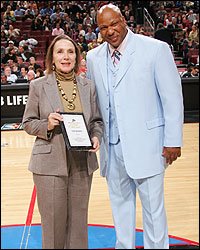
One of the women who wrote me was 77-year old Elin Danien, the founder of BREAD UPON THE WATERS, a unique scholarship program for non-traditional students at the University of Pennsylvania. (She's pictured above receiving a "Hometown Hero" award in November of 2005 from the Philadelphia 76ers.)
Here's what I discovered about the program when I went to its description on the UPenn website:
Bread Upon the Waters is the only scholarship of its kind -- specifically designed to benefit women over the age of 30 who wish to complete an undergraduate degree through part-time study at the University of Pennsylvania.
[The organization] was founded in 1986 by Elin Danien, a graduate of Penn's College of General Studies. Elin enrolled as a freshman at the age of 46 and graduated seven years later summa cum laude and Phi Beta Kappa. Her academic awakening and positive experience as an older woman student led her to establish a scholarship fund to help other nontraditional students realize their dreams.
According to Elin's note, the program has 60 graduates--33 of them with honors. Twenty-five women take courses each year. At age 68, Elin herself earned a PhD in anthropology. She asked me to give her a call so that she could tell me the story in her own words.
Stay tuned for more details about this wonderful woman and her on-going work.
* Photo Credit: Jesse D. Garrabrant NBAE/Getty Images